Vison d'Amérique (Neovison vison) American Mink — Peinture acrylique - Acrylic on canvas hyperréaliste de Robert M. Deschenes, peintre animalier naturaliste, Bas-Saint-Laurent, Québec
English follows
Discret et furtif, le Vison d'Amérique (Neogale vison) longe les berges des rivières et des lacs du Bas-Saint-Laurent depuis des millénaires. Robert M. Deschenes l'a observé à maintes reprises dans les environs de Saint-Hubert-de-Rivière-du-Loup — ce territoire où l'artiste vit et peint depuis plus de trente ans.
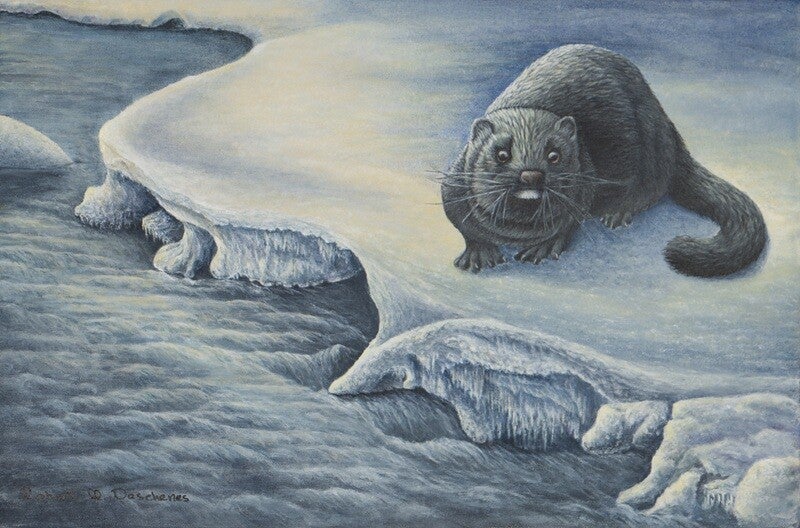
Dans cette toile hyperréaliste, le vison est saisi dans son milieu naturel riverain. Le pelage brun chocolat, aux reflets soyeux, est rendu avec une précision qui confond le regard : on perçoit presque le contact du poil, la densité de cette fourrure imperméable que l'animal doit à une vie semi-aquatique. Composition sobre, lumière froide et naturelle, attention au contexte écologique — c'est la signature d'un artiste qui est d'abord un naturaliste.
Acrylique sur toile
12 x 18 pouces
Dans cette œuvre d'art , l'artiste nous emmène dans un univers glacé et captivant. Au centre de la composition, un Vison d’Amérique se trouve sur un rivage glacé. Le vison, avec ses longs poils noirs - brunâtres et ses grands yeux expressifs, semble alertée, ses moustaches fines tendues et son corps prêt à réagir. Son pelage est dépeint avec une précision incroyable, donnant l'impression de la douceur et de la fourrure épaisse qui lui permet de résister au froid.
L'environnement qui l'entoure est également très soigneusement représenté. La banquise, avec ses contours irréguliers et ses parties transparentes où l'eau glacée est visible, crée un contraste saisissant avec la loutre. Les textures de la glace sont rendues de manière très réaliste, avec des reflets et des ombres qui donnent de la profondeur à l'image. L'eau, quant à elle, est peinte avec des tons bleus et gris, montrant les mouvements et la fluidité de l'élément vital dans cet habitat.
Le contraste entre la loutre, élément vivant et plein de dynamisme, et l'immobilité glacée de l'environnement crée une tension artistique. L'artiste a su capturer non seulement la beauté physique de la loutre, mais également l'esprit de son habitat arctique. Cette oeuvre est un témoignage de la maîtrise de l'artiste dans le domaine de l'art animalier naturaliste, où la réalité est peinte avec une intensité et un soin minutieux.
Discreet and elusive, the American mink (Neogale vison) has roamed the banks of the rivers and lakes of the Lower St. Lawrence for millennia. Robert M. Deschenes has observed it time and again in the vicinity of Saint-Hubert-de-Rivière-du-Loup—the region where the artist has lived and painted for over thirty years.
In this hyperrealistic painting, the mink is captured in its natural riverside habitat. The chocolate-brown coat, with its silky sheen, is rendered with such precision that it deceives the eye: one can almost feel the texture of the fur, the density of this waterproof coat that the animal owes to its semi-aquatic lifestyle. A sober composition, cool and natural light, and attention to the ecological context—these are the hallmarks of an artist who is first and foremost a naturalist.
Acrylic on canvas
12 x 18 inches
In this artwork, the artist takes us into a frozen and captivating world. At the center of the composition, an American mink stands on an icy shore. The mink, with its long black-brown fur and large, expressive eyes, appears alert, its thin whiskers taut and its body poised to react. Its fur is depicted with incredible precision, conveying the softness and thickness of the coat that allows it to withstand the cold.
The surrounding environment is also depicted with great care. The ice floe, with its irregular contours and transparent sections where the icy water is visible, creates a striking contrast with the otter. The textures of the ice are rendered very realistically, with reflections and shadows that add depth to the image. The water, meanwhile, is painted in shades of blue and gray, capturing the movement and fluidity of this vital element in the habitat.
The contrast between the otter—a living, dynamic creature—and the frozen stillness of the environment creates an artistic tension. The artist has captured not only the physical beauty of the otter but also the spirit of its Arctic habitat. This work is a testament to the artist’s mastery of naturalistic animal art, where reality is rendered with intensity and meticulous care.